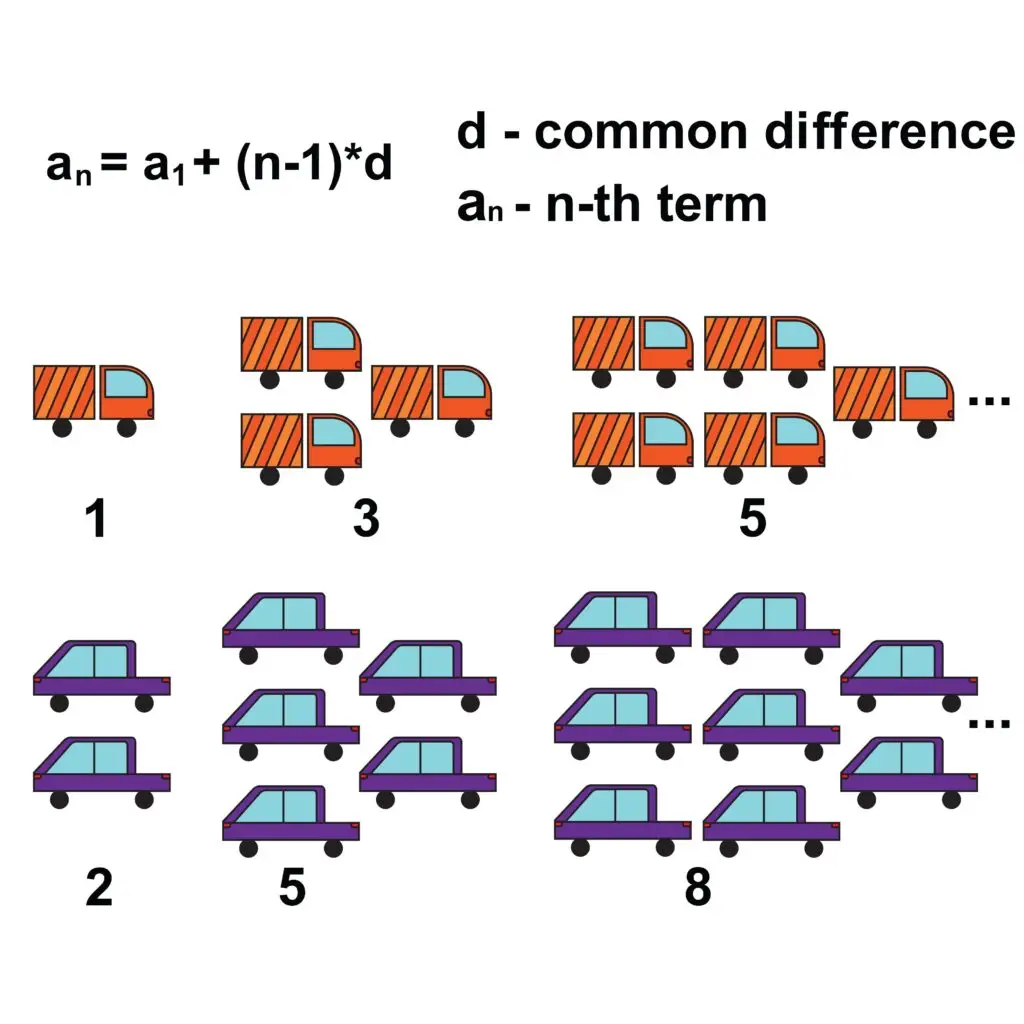
Arithmetic Sequence
What is an Arithmetic Sequence?
An arithmetic sequence is a list of numbers where the difference between each pair of consecutive numbers is always the same. For example, in  , the difference is
  .
.
General Form of an Arithmetic Sequence
An arithmetic sequence can be written as: 
where:
 is the first term,
 is the common difference, and
- each term is calculated by adding to the previous term.
For example, in the sequence  :
:
- The first term is
 ,
, - The common difference is
 , because
  and
and  .
.
Key Characteristics
- Common Difference: The common difference is found by subtracting any term from the term that follows it:
 where
where  is the
  -th term and
  is the term before it.
 - Formula for the -th Term: The -th term of an arithmetic sequence is given by:

- where:
- is the -th term,
- is the first term,
- is the common difference, and
- is the position of the term in the sequence.
- Example: For the sequence
 :
:
 ,
,  ,
,- To find the
 -th term:
- where:
Applications of Arithmetic Sequences
- Real-Life Examples:
- Counting patterns, such as even numbers (
 ) or odd numbers (
 ).
). - Incremental savings: If you save a fixed amount each week, the total savings follows an arithmetic sequence.
- Counting patterns, such as even numbers (
- Mathematical Applications:
- Used in summation problems and number patterns.
- Helpful in solving problems involving linear relationships in algebra and geometry.